It was sad to hear of the passing of Barry Higgins. I had known Barry since 1975 and I think he could be considered as Australia’s most significant bushwalker. He died on 1 October 2026 at the age of 91.
I met Barry when I joined the Kameruka Bushwalking Club, and was with him on a number of club walks. Most of these he led.
He was born in country NSW, but grew up in Sydney. I think his first bushwalking club was the Rucksack Club. But I know he considered himself as a “freelance” bushwalker (his term), walking with whoever wanted to join him on interesting and challenging walks. In the late 1950’s after this first walk in Tasmania, he was captivated by the Island and the bushwalking opportunities it offered. Back in Sydney, he quit his job and moved to Hobart. He found employment and resumed bushwalking. He found the local Hbart bushwalking club a bit conservative and stuffy, so started his own club which was called the “Van Demons”. He did many long walks in the Tasmanian bush. He was perhaps best know for being in the party, with the late John Elliot and Patrick Conaghan, that completed the first traverse of the Western Arthur Range in the summer of 1960-61.
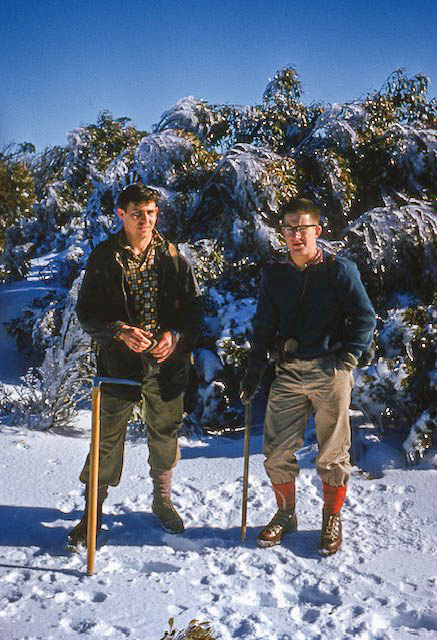
Photo – Patrick Conaghan and Barry Higgins on Mt Wellington in Tasmania (photo courtesy of Patrick Conaghan).
I don’t have a list of all his Tasmanian walks, but I can recall talking with him about walks I had just completed like the Prince of Wales Traverse, and he too had traversed that range. And, one very obscure range that I visited was the Jubilee Range (which lies between the Snowy Range and Mt Anne. Yes, he too had been there. Much later, when I was in a party that traversed Mt Hopetoun, I later read a letter Barry had posted back to bushwalking mate, Ted Hartey in Sydney around 1961, where he describes a long summer walk he had just completed. His party had started by traversing Mt Hopetoun, then traversed what he called the “Whiz Range” (also known as the Craycroft Hills, Tam O’Shanter and now known as The Crest Range), then they traversed the Spero Range and lastly the Norolds Range. Wow!
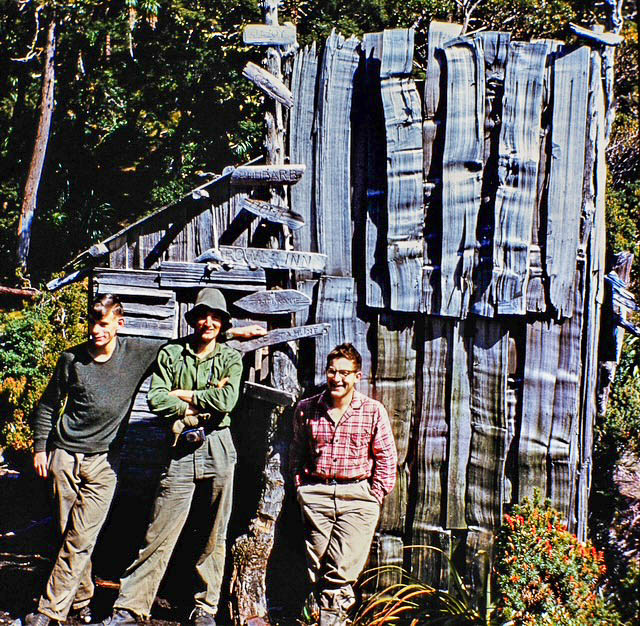
Photo – Patrick Conaghan, John Elliot and Barry Higgins outside a hut in Tasmania (photo courtesy of Patrick Conaghan).
When, he returned to Sydney, he mainly walked with the Kameruka Bushwalking Club. I know he explored a lot of the country around the Capertee Valley (I think his family had lived at Clandulla for a period). This was at a time when this country was largely unknown to bushwalkers.
I first heard of Barry when I read a copy of the Kameruka Bushwalking Club magazine, which was on sale at Paddy Pallins bushwalking shop in Sydney. An article described a walk that Barry had led from Mt Cameron to Mt Mistake and beyond. This was in the days when the only map was the Wallerawang 1 inch to the mile sheet. The ridge system was very complex between Mt Cameron and Mt Mistake as well as being not only featureless but also very scrubby. Barry managed the navigation for this. Map and compass navigation, with some dead reckoning. In that country, it is very difficult to pick up the ridge junctions and navigation is very challenging indeed. Trivial now with GPS units.
The first walk I did with Barry was a Coxs River walk, where we camped at the junction of the river and Merrigal Creek. On the second day we left the river and walked up Merrigal Creek. Part way up, our progress was stopped by a huge waterfall, which we scrambled around. I can remember being impressed with the very small home made pack that Barry carried.
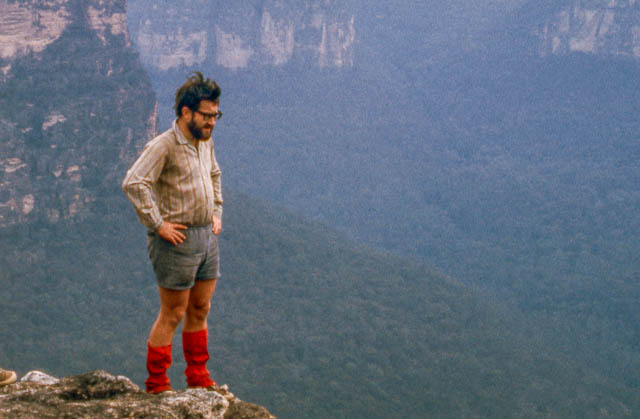
Photo – Barry and other walkers on the “Inca Pathway” (Barry’s name), near Glen Trig, Mt Morgan Plateau.
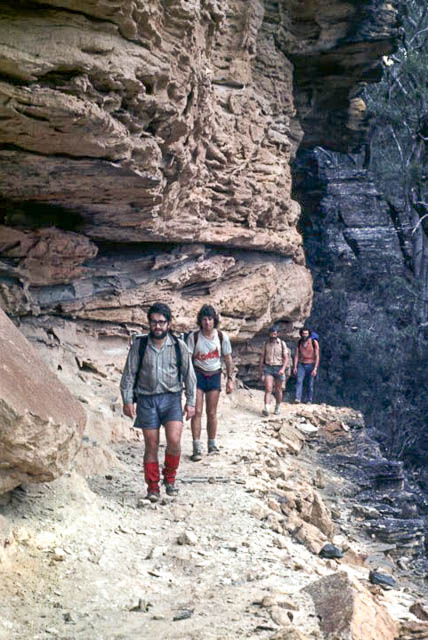
A later walk, I did that Barry also led, was a long weekend walk starting at Newnes. On the first day, we walked all the way down the Wolgan River to the Capertee Junction. After camping at the junction, we found a pass onto the plateau between the Wolgan and Capertee (which we called the Mt Morgan Plateau). An excellent walk. I learnt a lot from walking with Barry. He did not teach, but I learnt from what he did and what he said. On this walk, we had a very ambitious first day. To complete with an ordinary part of bushwalkers he had an early start of the Saturday, we left Newnes around 6 am and then stopped at the Rocky Creek junction for breakfast. I can remember using this same method for Blue Breaks walks were we would walk out from Kanangra Walls to the Coal Seam Cave on a Friday night, then after an early start, have breakfast on the Kowmung River.
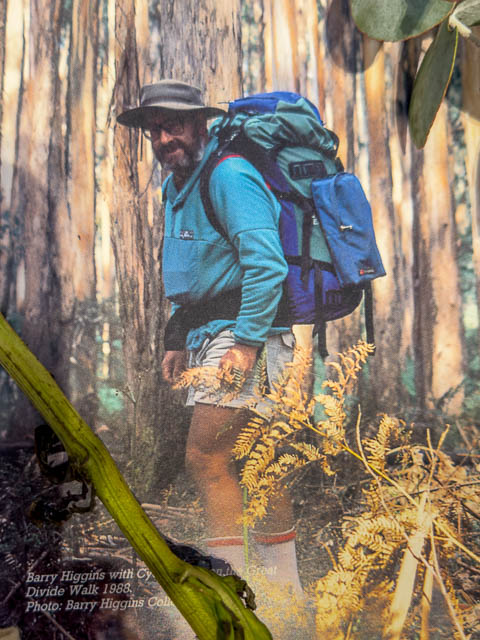
As well as his “freelance” policy, he also had a passion for doing full range traverses. He liked to walk along the skyline from one end of the range to the other as far as possible. This had led him to the Western Arthurs and many other full range traverses in Tasmania. But later, in the 1980’s, he competed, with Steve Tremont, the ultimate Australian transverse – the full traverse of the Great Dividing Range from Western Victoria to Cape York. The walk took over a year. He had also been i the first party to traverse the Flinders Range in one continuous effort (77 days), and had done a first or early traverse of the Chewings Range (Part of the McDonnel Ranges in Central Australia).
Photo – Barry on the Great Dividing Range Traverse (photo from his funeral)
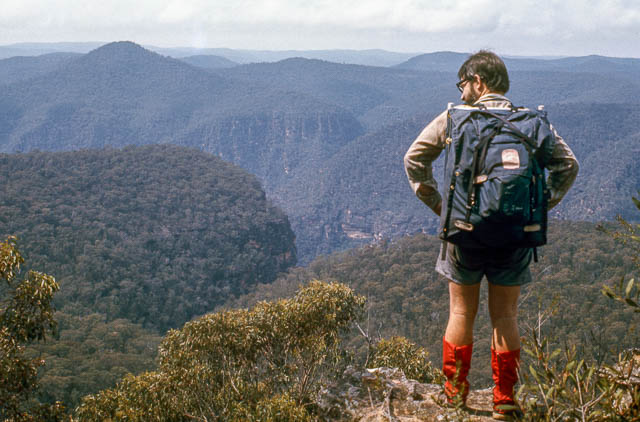
At Barry’s funeral, one of the eulogies was given by bushwalker Alan Barclay. He emphasised that Barry did not set out to be the first to do anything, but rather he would climb a mountain or traverse a range because that was what he wanted to do. And he also liked to simply gaze out and admire the view.
Photo – Barry on the Mt Morgan Plateau
But one trip that Barry was in the first party was the “Three Peaks“. A weekend walk from Katoomba along Narrow Neck and then climbing My Cloudmaker, Mt Paralyser and then My Guouogang and returning to Katoomba in a weekend. This became a classic hard bushwalk for NSW bushwalkers.
WhenI knew Barry, he worked for Paddy Pallins, as the person in charge of Outdoor Agencies, their importing firm, and I can remember him giving me samples of gear to try out – eg new parkas and abseiling devices. This was a good place for Barry to work given his passion for bushwalking.
But his main passion was for Valerie Attenbrow, his partner. Val was a very well known and highly regarded archeologist who worked on Aboriginal archeology at the Australian Museum. In their later years, they had moved to a nursing home, and when Val died a few months ago, Barry lost the will to keep living.
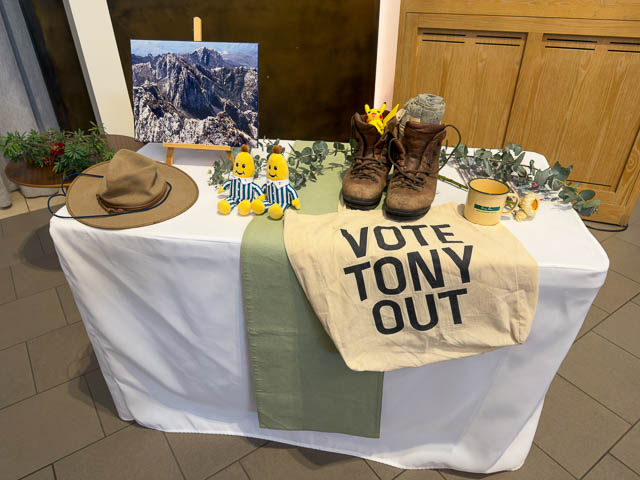
Photo – Bushwalking display at Barry’s funeral –