I had attempted to photograph this evening comet two days earlier from my balcony in suburban Sydney. I had spotted the comet using a camera and then looking on the back screen as it was far too dim to see with the naked eye and even with binoculars. But that evening had some faint cloud. The next night was overcast, but the evening of the 5 May was clear. So back out onto the balcony with the tripod and camera.
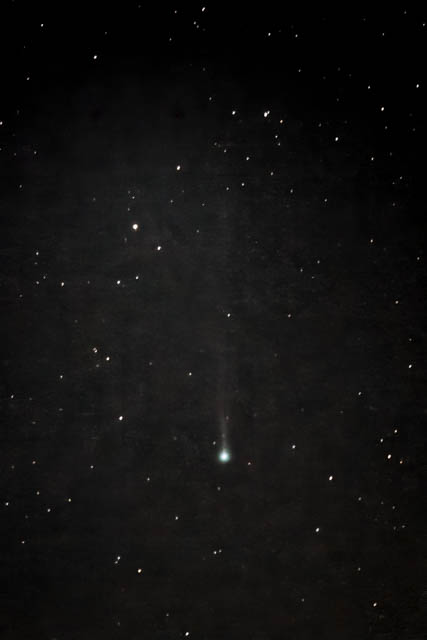
The comet was not too hard to spot, as I had loaded its orbital elements into Stellarium planetarium software. So I knew roughly which part of the sky to look. I first took photos using a 50 mm f 1.4 lens and then examined the back screen of the camera – zoomed in, and soon spotted the distinctive green splodge of the comet. I then repositioned the camera slightly and changed to a 135 mm f 108 lens.
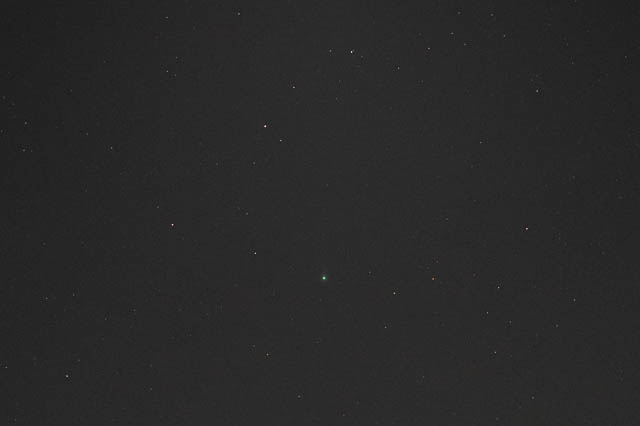
The light pollution in Sydney is very bad, and from just one image it was hard to discern the tail of the comet, even with histogram stretching in Photoshop. Here are some more photos. They are taken at 135 mm, f 1.8, 2.5 seconds, 6400 ISO at about 6:45 pm. The photos are heavily cropped.
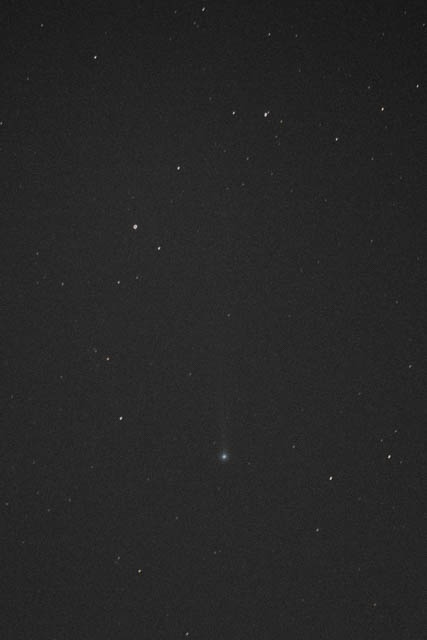
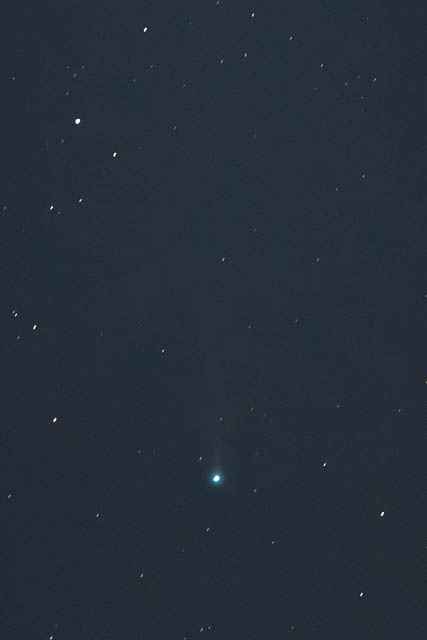
A wider view –
Hi David, you are a man of many talents. Did you try the 300mm or was the field of view too small, of course exposures would have to be about 1 sec (could be stacked).
PS: How are you finding the 300 + 2x for birds, my big lens is starting to be a load to carry. Any thoughts on the new FE 100-400 F4.5 instead (only 1.8kg).
I did try the 300mm 2.8 but used it without mounting it on the tripod (just mounted on the camera on the tripod) and was very poorly balanced. So hard to locate the comet. If the comet had been brighter or I had been in a dark sky location then it would have been good, and I would have used the tripod foot on it.
The 300 and the 1.4x or 2x is excellent for birds (I mainly use the 2x). Excellent quite light combination, fast focusing and sharp.